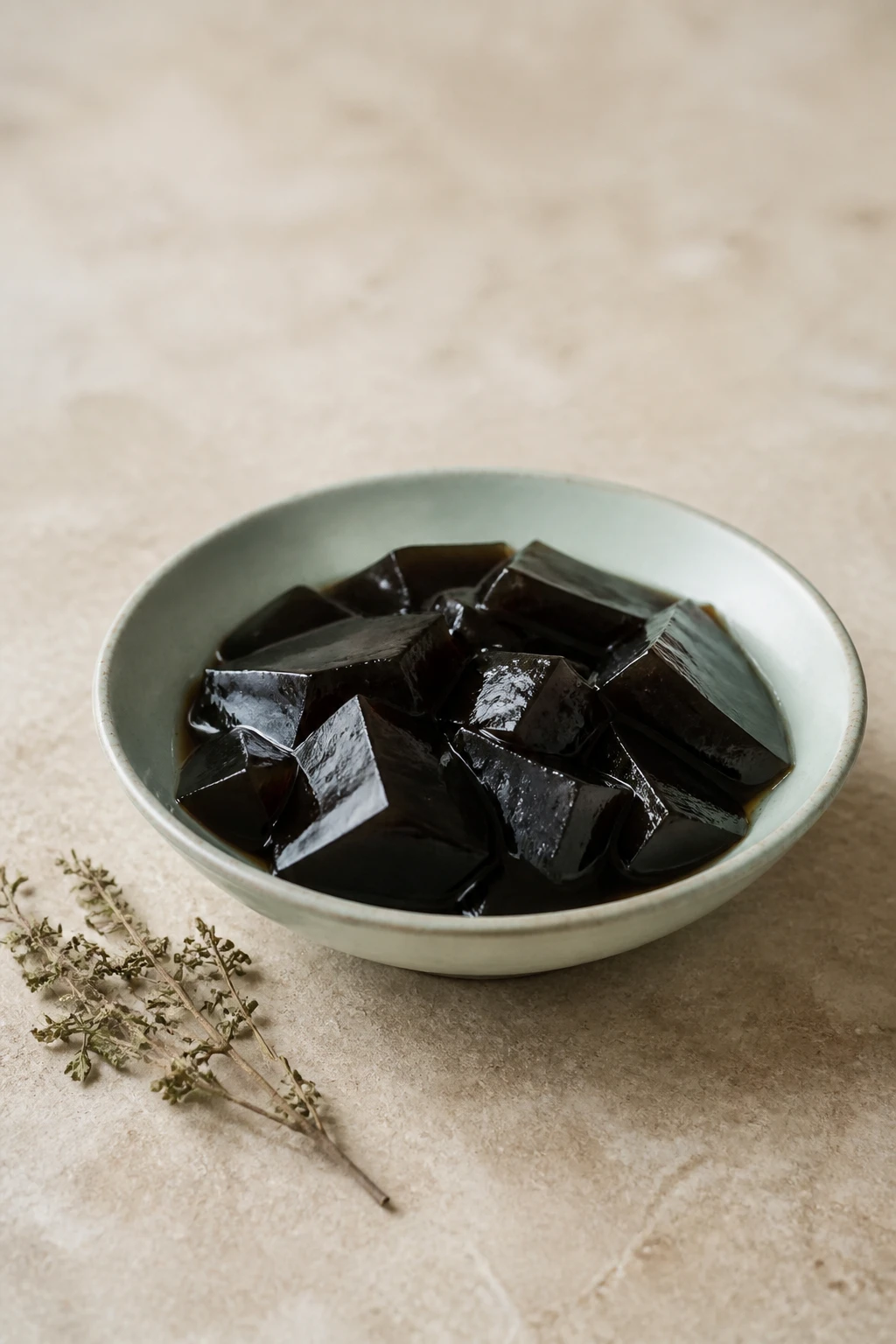
Grass jelly is a dark, softly set jelly made with mesona, an herb whose dried stems and leaves are extracted in water. This Atlas Record covers the chilled jelly associated with summer service in Taiwan. Its aroma is herbal; syrup and toppings help determine how sweet a serving tastes. It does not combine that cold form with hot 燒仙草, and it does not treat any topping or syrup as part of the dessert’s fixed identity.
For another dessert associated with Taiwan, explore Taiwan Pineapple Cake. Its crumbly baked crust and soft fruit filling offer a contrast to chilled grass jelly.
What is grass jelly?
Taiwan’s Taoyuan District Agricultural Research and Extension Station describes mesona stems and leaves being dried, extracted in water, and combined with starch to form black grass jelly. The same report identifies aroma and gel strength as important quality characteristics. Taoyuan District Agricultural Research and Extension Station
The controlled values therefore stay narrow: mesona is the defining ingredient, simmered and set-gelled describe the high-level process, herbal describes the characteristic aroma direction, and jelly-like describes the set form. Exact starches, alkali, concentrations, cooking times, and recipes belong to a recipe rather than this concept record.
Why does it set?
Mesona contains gel-forming polysaccharides. Taiwan’s Ministry of Agriculture knowledge portal connects mesona cultivation and processing quality with aroma and gel strength, while a peer-reviewed food-science study found that Mesona polysaccharide changes the pasting and gel properties of rice-starch gels. Taiwan Ministry of Agriculture knowledge portal PubMed record for the primary study
That evidence explains the set texture without turning this page into a recipe or implying that every producer uses rice starch. Finished products can differ in firmness, color, sweetness, and added flavor.
Taiwan and seasonal context
The agricultural report lists cultivation in several parts of Taiwan and calls mesona an important specialty of northern Taiwan. It also describes black grass jelly as a popular summer cold-dessert material and notes a separate winter product, hot 燒仙草. Taoyuan District Agricultural Research and Extension Station
The Atlas assigns Taiwan and summer as supported associations, not as an exclusive birthplace or a claim that grass jelly is unavailable elsewhere. The origin field remains unset.
What to expect
Chilled grass jelly is commonly cut or spooned into portions and served cold. Its mesona aroma can be noticeable, while the sweetness depends on the syrup, drink, or toppings around it. Because the institutional sources do not establish one characteristic sweetness level for the finished dessert, this record does not assign lightly-sweet even though sweet presentations are common.
Toppings change the ingredient and allergen profile. An empty allergen array means no common allergen has been established for the scoped base concept; it never means an individual serving is allergen-free. Check the exact ingredients and cross-contact conditions with the producer.
This record also makes no health claim. Traditional-use descriptions and laboratory research are not evidence that a serving prevents or treats disease.