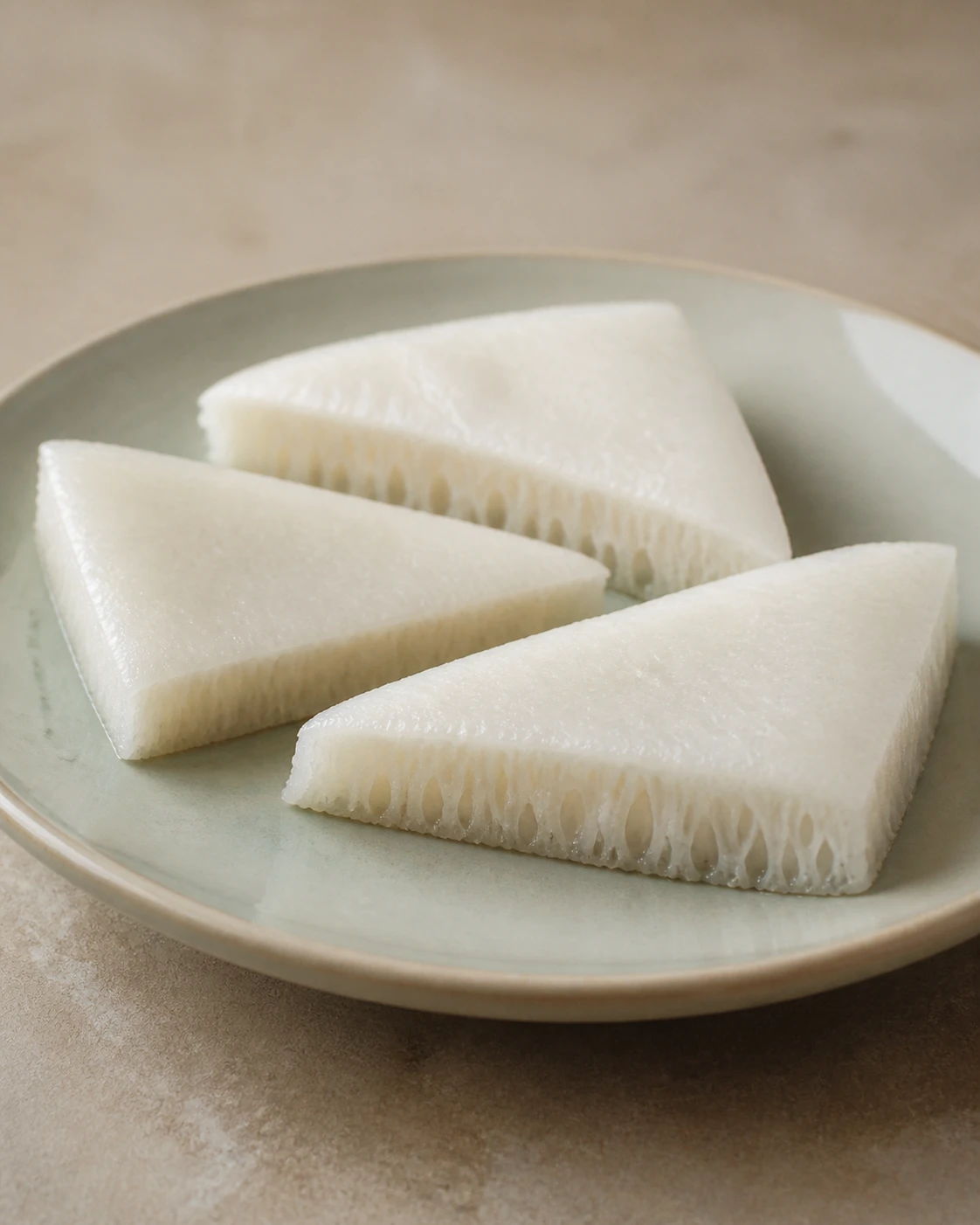
White sugar sponge cake is a pale steamed rice cake built around a fermented batter. Hong Kong government food-surveillance material uses “white sugar sponge cake” for 白糖糕 and includes it among Hong Kong-style cakes and puddings. A separate official market glossary uses the closely related English label “steamed white sugar cake.” Hong Kong Government · Hong Kong Food and Environmental Hygiene Department
What the Atlas record covers
This record covers the rice-batter cake form whose comparison-defining steps are fermentation and steaming. It does not cover wheat sponge cake, baked sponge cake, steamed wheat ma lai gao, glutinous-rice New Year cake, or every regional food whose name translates loosely as “white cake.”
The protected Lunjiao Cake specification provides a precise representative process: rice is washed and soaked, milled with water into batter, mixed with sugar syrup, inoculated with a rice starter, fermented, steamed, cooled, and sliced. The Atlas uses that primary specification to support rice, fermented, and steamed, while clearly treating Lunjiao Cake as a narrower Guangdong form rather than a label for every white sugar sponge cake. China National Intellectual Property Administration
Texture and flavor
The same specification describes Lunjiao Cake as pale and glossy, fine-textured, soft yet resilient, lightly sweet, and carrying natural fermented-rice acidity. Those details explain the cake’s characteristic open structure, but recipes and fermentation intensity vary. The controlled comparison therefore stays conservative: lightly-sweet and soft, without claiming that every example has an identical sourness, translucency, pore pattern, or chew. China National Intellectual Property Administration
Compare it with Double Skin Milk: both are steamed, but Double Skin Milk sets as a milk-and-egg custard, while this cake is made from fermented rice batter.
Guangdong and Hong Kong association
Lunjiao Cake has a current Foshan local standard and protected geographical scope in Shunde, Guangdong. In Hong Kong, government surveillance explicitly groups white sugar sponge cake with Hong Kong-style desserts and a later Centre for Food Safety study sampled 白糖糕 among Chinese and Thai cakes sold locally. These are strong regional associations, but they do not prove a single origin for the broader English record, so the Atlas leaves the origin field unset. National Public Service Platform for Standards · Hong Kong Centre for Food Safety
Serving and formulation note
Cooling is part of the protected representative process before slicing and packaging, and Hong Kong’s market study examined cakes sold under chilled or room-temperature handling. The Atlas therefore uses room temperature as the characteristic comparison state, not as universal storage advice. Buy from a reliable seller, follow package directions, and avoid leaving a moist cooked rice cake at unsafe temperatures.
The core process does not establish that every seller’s product is vegan, gluten-free, or free from major allergens. Modern leaveners, oils, release agents, toppings, and shared equipment can differ. Read the exact ingredient and allergen information and ask the producer when it is unclear.