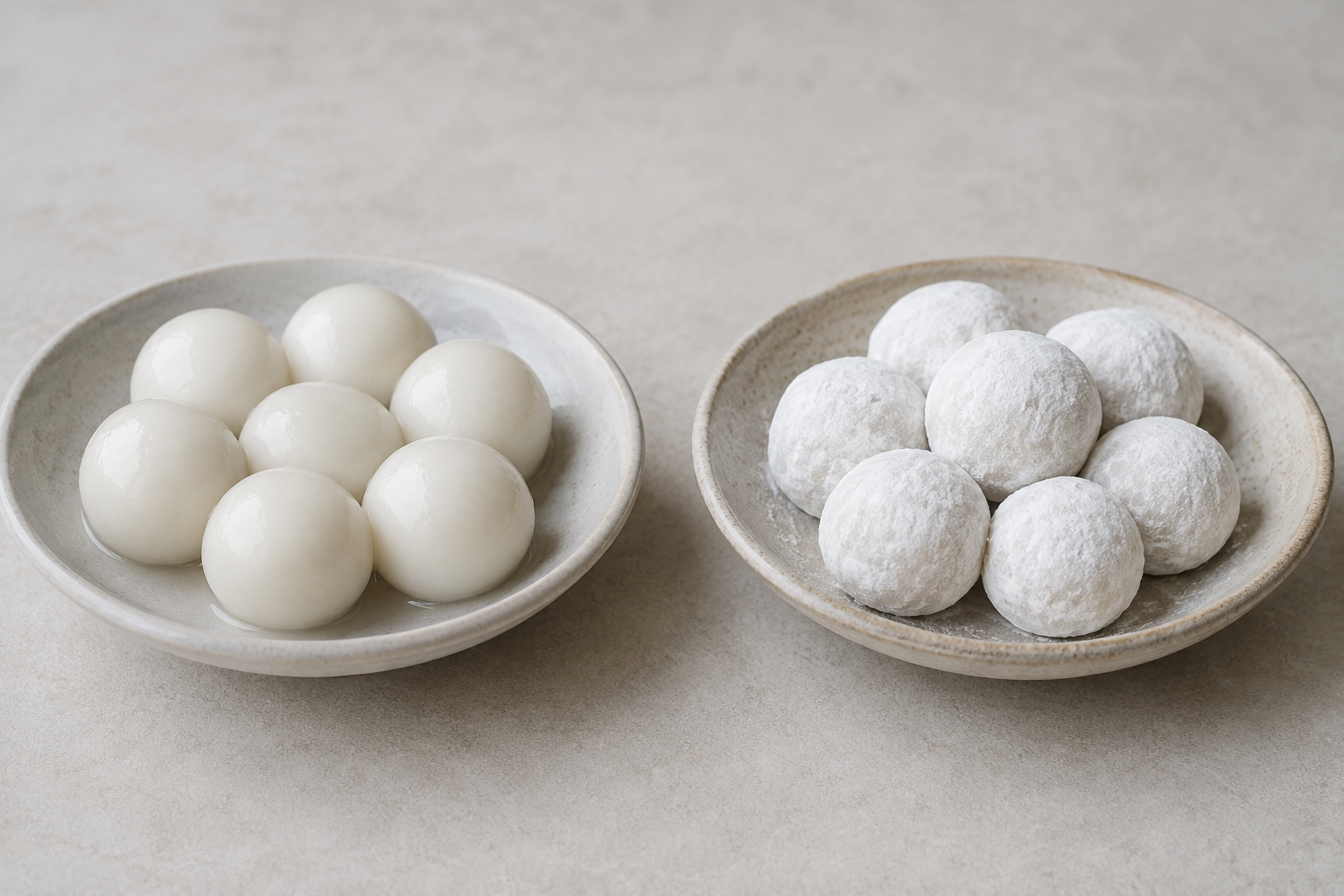
Tangyuan and yuanxiao are closely related glutinous-rice foods associated with the Lantern Festival, but they are not always made in the same way.
The clearest modern distinction is this: tangyuan are usually wrapped, while yuanxiao are usually rolled.
Both terms also have regional histories, so real-world naming is less tidy than a simple either-or rule. The Atlas identity page for the wrapped form is the Tangyuan Dessert Record.
Tangyuan and yuanxiao at a glance
| Dimension | Tangyuan | Yuanxiao |
|---|---|---|
| Basic material | Glutinous rice flour | Glutinous rice flour |
| Common shaping method | Moist dough is wrapped around a filling | A filling is repeatedly moistened and rolled in dry flour |
| Surface | Usually smoother | Often drier and more flour-dusted |
| Wrapper structure | More cohesive and elastic | Built from successive layers of flour |
| Common modern naming association | More common in southern usage | More common in northern usage |
| Festival association | Lantern Festival and reunion | Lantern Festival |
The Hunan Administration for Market Regulation summarizes the familiar distinction as “wrapped tangyuan, rolled yuanxiao.” It describes yuanxiao as filling rolled repeatedly through dry glutinous-rice flour, while tangyuan use a moist dough wrapped around the filling. Hunan Administration for Market Regulation
How tangyuan are formed
For tangyuan, glutinous rice flour is mixed into a moist dough. A portion of dough is shaped around a filling and closed by hand.
This method creates a comparatively smooth, cohesive outer layer. After boiling, the wrapper becomes soft and chewy.
How yuanxiao are formed
Yuanxiao begin with small pieces of filling rather than a sheet of prepared dough. The pieces are moistened and rolled through dry glutinous-rice flour several times. Each pass adds another layer.
The result is usually round but may look more powdery or uneven before cooking. The layered flour coating can also produce a looser surface than the wrapped tangyuan method.
Why the names still overlap
The method distinction is useful, but the vocabulary also reflects regional language.
A Hong Kong Public Libraries guide records 湯丸 in Guangdong, 湯糰 in Shanghai, 元宵 in Beijing, and other local terms. It also connects these foods with the Lunar New Year, Lantern Festival, Winter Solstice, and reunion symbolism. Hong Kong Public Libraries
This means two speakers may use different names for similar-looking foods, especially in family or regional contexts. A menu, package, or festival description may therefore prioritize local convention over a strict technical distinction.
Are their fillings different?
Sweet fillings such as black sesame and peanut occur in both categories. Modern guidance sometimes describes yuanxiao as predominantly sweet while noting that tangyuan may also have savory fillings, but filling alone is not the most reliable way to distinguish them.
The shaping method is the stronger practical clue.
Which word should you use?
Use tangyuan when referring to the wrapped, smooth-skinned dumpling represented by the Atlas Record.
Use yuanxiao when the filling has been rolled repeatedly in dry glutinous-rice flour, or when accurately preserving a northern regional name.
When discussing family traditions or historical sources, retain the term used by the source and explain the context rather than silently standardizing it.