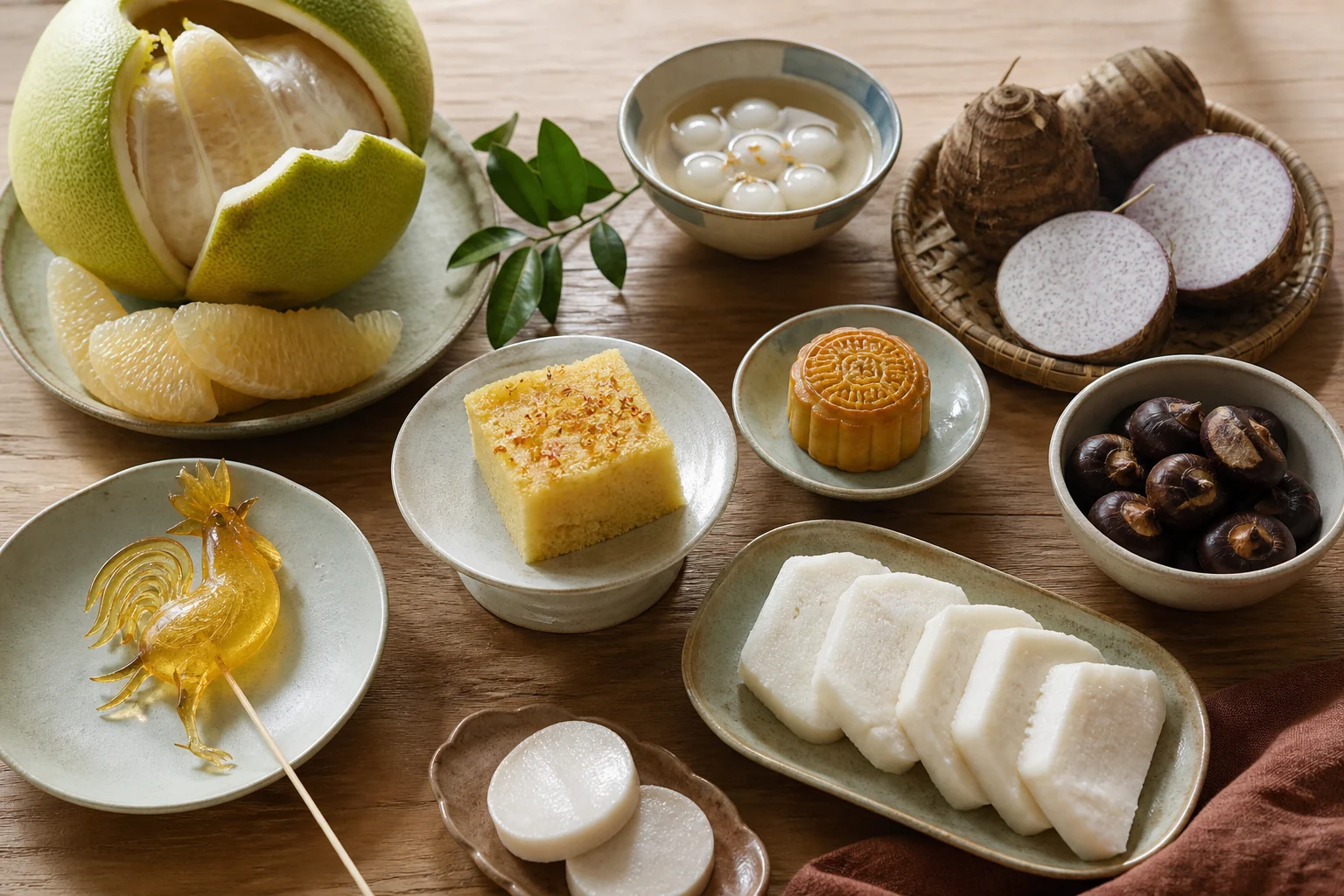
Mooncakes are a central Mid-Autumn food, but what surrounds them varies by region and community. This guide introduces documented sweets and festival foods without suggesting that every Chinese family shares one menu.
For the festival’s best-known pastry, use the Mooncake Dessert Record. For a practical first taste, continue to What Does a Mooncake Taste Like?.
What appears on Mid-Autumn tables besides mooncakes?
One documented example comes from Macau. The Macau Cultural Heritage Bureau lists glutinous rice balls, taros, Shatian pomelos, and water chestnuts among the usual festive foods of Macau’s Chinese community. That is a regional record, not a national checklist.
Osmanthus cake (桂花糕, guìhuā gāo)
Osmanthus blossoms around the Mid-Autumn season and appears in documented festival sweets and drinks. Osmanthus cake is gently sweet and floral, while its texture varies across rice-cake, wheat-based, and set forms. Because the name covers more than one preparation, it is better treated as a family of osmanthus sweets than one fixed cake.
Hakka moonlight cake (月光糕, yuèguāng gāo)
Moonlight cake is a white rice-flour sweet associated with Hakka communities in Meizhou, Guangdong. A Guangdong provincial local-history article cites a Republic of China–era Wuhua County gazetteer recording “moon cake,” peanuts, and pomelos in Mid-Autumn offerings, and explains that the “moon cake” in that record refers to moonlight cake.
The same source describes cakes stamped with auspicious characters and records the craft’s addition to Meizhou’s municipal intangible-cultural-heritage list in 2022. Common fillings include sesame, peanut, and candied winter melon, but recipes vary.
Chaozhou Longhu steamed cake (龙湖炖糕, Lónghú dùn gāo)
Longhu steamed cake is a thin white glutinous-rice sweet from Longhu in Chaozhou. It belongs to the broader yúnpiàn gāo or “cloud-slice cake” family. The Guangdong local-history account cites the Chaozhou gazetteer for using cloud-slice cake in moon worship, describes Longhu’s version as a traditional Mid-Autumn food, and notes the craft’s inclusion on a Chaozhou municipal intangible-cultural-heritage list in 2019.
The slices are documented as white, thin, cleanly sweet, and flexible enough to separate like pages. This is a place-specific tradition, not a universal Mid-Autumn dessert.
Yangjiang sugar rooster (糖鸡, táng jī)
Yangjiang sugar rooster is a molded sugar confection shaped like a rooster. The Guangdong source describes red, yellow, and white examples, with red most common, and records a Yangjiang-dialect wordplay between “red” and “male.” It also notes the craft’s 2022 inclusion in Yangjiang’s intangible-cultural-heritage list.
This is a regional confection and display or gift tradition, not a plated dessert shared everywhere.
When festival taro becomes a sweet
Taro is present in several documented Guangdong Mid-Autumn customs, but the festival food is not automatically dessert. Foshan examples include a “mother taro” with smaller taros attached and steamed taro-rice balls seasoned with sesame, scallion, and oil. Sweet taro preparations belong on a dessert path only when sugar and method make them sweets.
In the Chaozhou–Shantou area, sugar-coated taro is one such sweet direction. Claims about symbolism or exact method should stay tied to a source for the particular locality.
A Macau note on glutinous rice balls
The Macau cultural-heritage record includes glutinous rice balls (汤圆, tāngyuán) among local Mid-Autumn foods. This supports a Macau context only; it should not be rewritten as a nationwide rule.
Not every festival food is dessert
- Pomelo: a seasonal fruit offered and shared in documented festival contexts.
- Plain taro: a festival food or offering in some communities; only particular sweet preparations are desserts.
- Tea: a common pairing, but a drink rather than a dessert.
- Crab and snails: savory seasonal or regional foods with documented festival roles.
The distinction keeps the festival picture accurate: a food can matter to Mid-Autumn without being sweet, and a regional custom should remain labeled by place.
For more comparisons, explore Chinese desserts by texture and ingredients. The Atlas includes everyday desserts as well as festival foods.