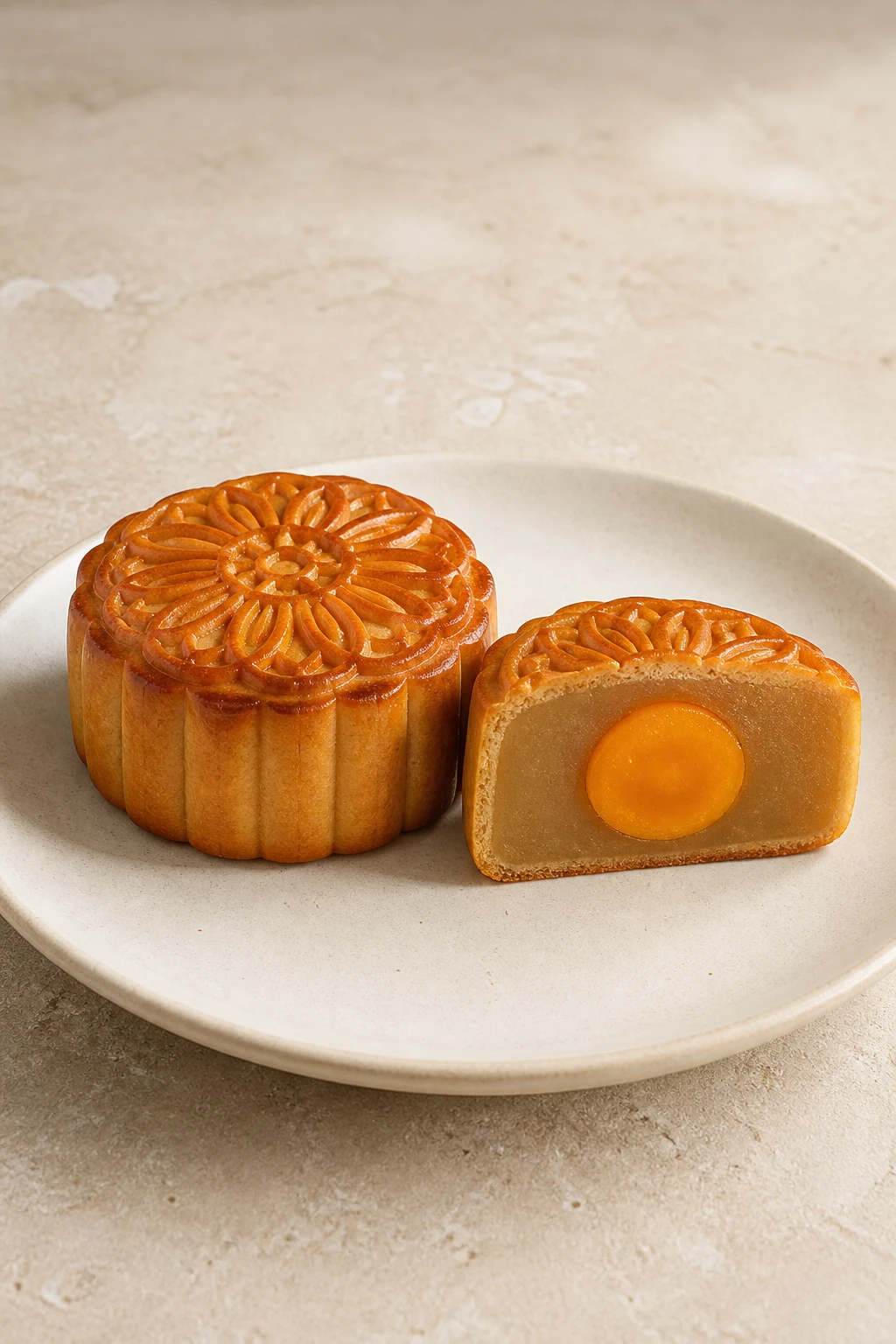
A baked mooncake is a filled Chinese festival pastry. This Atlas Record follows the familiar sweet, molded baked profile rather than treating every food called “mooncake” as one comparable object. Snow-skin, ice-cream, and flaky regional forms differ enough in wrapper, serving state, and preparation to remain outside this record.
What this record covers
China’s current mooncake quality standard defines mooncakes broadly as filled traditional festival pastries made from grain flour, starch, tuber flour, beans, oils, and optional sugar, and eaten mainly for the Mid-Autumn Festival. It also classifies mooncakes by processing method and regional style, confirming that the category contains structurally different forms. Huadu District Market Regulation explanation of GB/T 19855-2023
For useful comparison, this record narrows that broad category to a common sweet molded form: a wheat-based wrapper surrounds a filling, the cake is shaped in a mold, and the assembled pastry is baked. A Beijing market-regulator guide describes a Cantonese example made with wheat flour, syrup, oil, and alkaline water, then filled, shaped, brushed with egg, and baked to a soft crust. Beijing Administration for Market Regulation
Shape, baking, and texture
The mold is not only decorative. A documented Lian Xiang Lou process presses the filled dough in a wooden mooncake mold, releases the patterned cake, bakes it, brushes the surface with egg yolk, and bakes it again. The finished cakes are cooled before packaging. Ministry of Commerce old-brand museum
The Atlas therefore uses molded-pressed and baked as the defining preparation methods and soft as the controlled texture for this scoped record. Flaky Suzhou pastry, chilled snow skin, and ice-cream mooncakes are not alternate textures of this record; they belong in comparison articles or separate future records.
Fillings and flavor
Lotus seed and red bean pastes are familiar sweet directions, while salted egg yolk can add a salty center and nut mixtures can change both flavor and texture. The national-standard explanation defines naming thresholds for lotus, egg-yolk, nut, and fruit fillings, showing why the filling name and product label matter. Huadu District Market Regulation
This record uses sweet as its controlled flavor because it represents the common sweet molded profile. It does not imply that every baked regional mooncake is sweet. For a wider choice map, see What Does a Mooncake Taste Like? and Mooncake Fillings Explained.
Mid-Autumn and reunion
Mooncakes are closely associated with the Mid-Autumn Festival. The Smithsonian National Museum of Asian Art describes the festival as a gathering of family and friends and identifies mooncakes as rich pastries with sweet or savory fillings. Smithsonian National Museum of Asian Art
The Atlas assigns mid-autumn-festival and family-reunion while keeping the wording scoped: celebrations, gifting, fillings, and household practices differ by region and community. This evidence supports cultural association, not one precise historical origin, so the origin field remains unset.
Serving and allergen note
The characteristic serving state for this profile is room temperature. That value describes comparison, not storage safety. Formulas and packages differ, so follow the product’s date mark and storage directions; products labeled for refrigeration still need refrigeration. The Singapore Food Agency distinguishes baked traditional mooncakes from snow-skin products and advises storing unpackaged traditional mooncakes in a cool, dry place. Singapore Food Agency
Wheat is defining in the documented wrapper, and egg is commonly used as a surface wash or filling component. Both are major allergens in the U.S. framework. A flag does not mean every baked mooncake contains that allergen, and the absence of another flag never means a product is safe. Read the complete ingredient information every time and ask the producer when it is unclear. U.S. Food and Drug Administration
For forms outside this record’s boundary, continue to Snow Skin vs Baked Mooncakes or the Regional Mooncake Starter Guide.