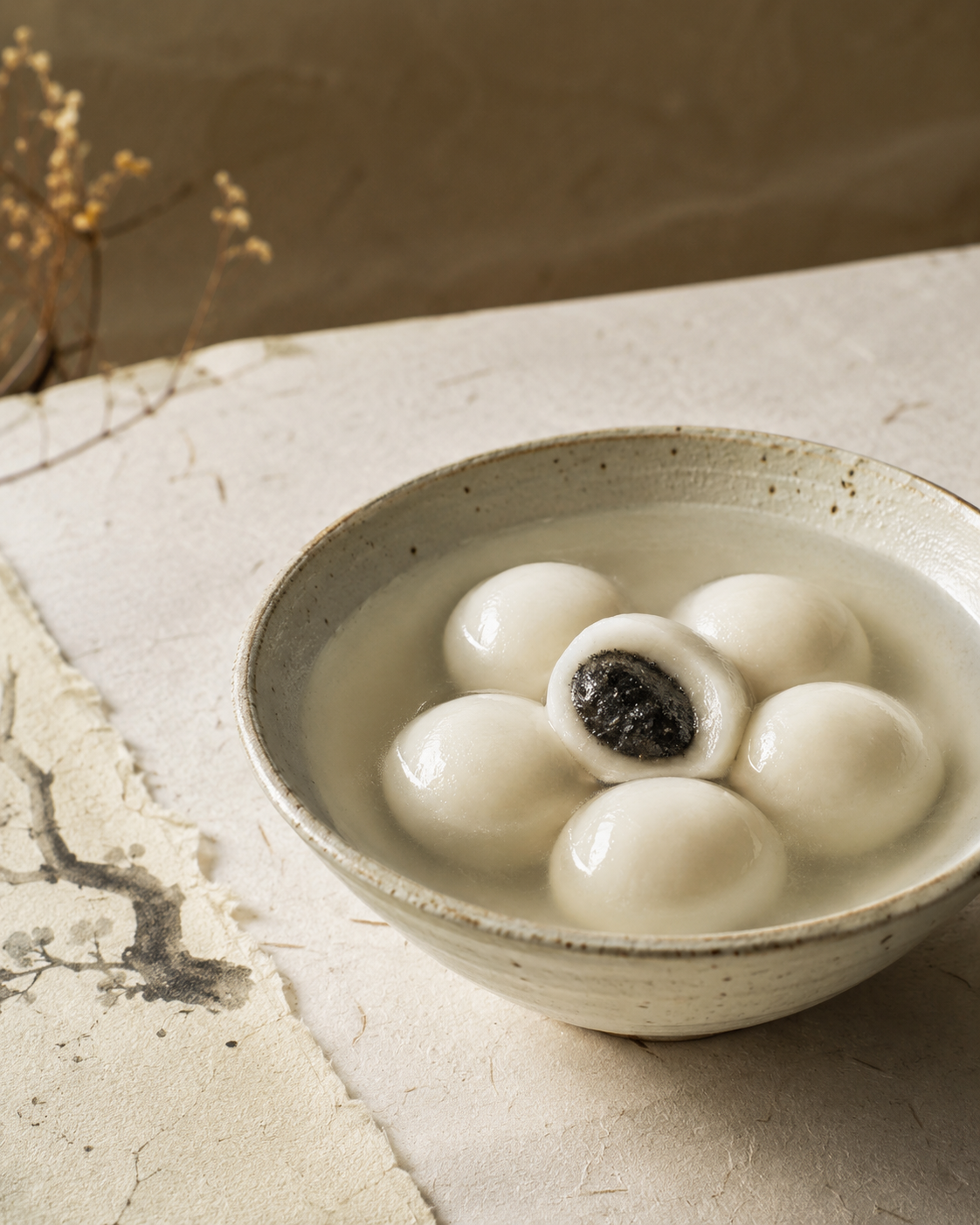
What are tangyuan?
Tangyuan are soft, chewy dumplings made with glutinous rice flour. They are normally boiled and served hot, either in a light liquid or as part of a sweet soup.
Sweet versions may contain fillings such as black sesame or peanut, although fillings and serving styles vary. The glutinous rice wrapper gives tangyuan their characteristic yielding, slightly sticky chew.
This Atlas Record covers tangyuan as a sweet dessert. It does not imply that every tangyuan is sweet or that all versions contain the same filling.
Names and regional variation
The name 汤圆, literally referring to round dumplings served in liquid, is widely used in southern China. Regional names include 湯糰, 汤团, and 湯丸. A Hong Kong Public Libraries cultural guide documents names including 湯丸 in Guangdong, 湯糰 in Shanghai, and 元宵 in Beijing. These naming traditions overlap, which is one reason tangyuan and yuanxiao are sometimes treated as synonyms. Hong Kong Public Libraries
In contemporary food guidance, however, tangyuan and yuanxiao are often distinguished by how they are formed. Tangyuan are wrapped from moist glutinous-rice dough, while yuanxiao are built by repeatedly rolling a filling in dry flour. Hunan Administration for Market Regulation
See Tangyuan vs Yuanxiao: What’s the Difference? for a direct comparison of the two shaping methods.
Cultural context
Tangyuan are especially associated with the Lantern Festival. Their round shape and the similar sound of 汤圆 and 团圆, meaning reunion, support their familiar association with family togetherness.
They are also eaten in some communities during the Lunar New Year and Winter Solstice. These practices are not identical everywhere, so the dessert should not be presented as having one universal festival meaning.
What to expect
- A soft, chewy glutinous-rice exterior
- A smooth or granular filling, depending on the ingredients
- A hot liquid or sweet-soup presentation
- A gentle rice aroma followed by the stronger flavor of its filling
Black sesame and peanut are common fillings and are major allergens under the FDA’s U.S. labeling framework. Packaged and restaurant versions must be checked individually because recipes and cross-contact conditions vary. U.S. Food and Drug Administration