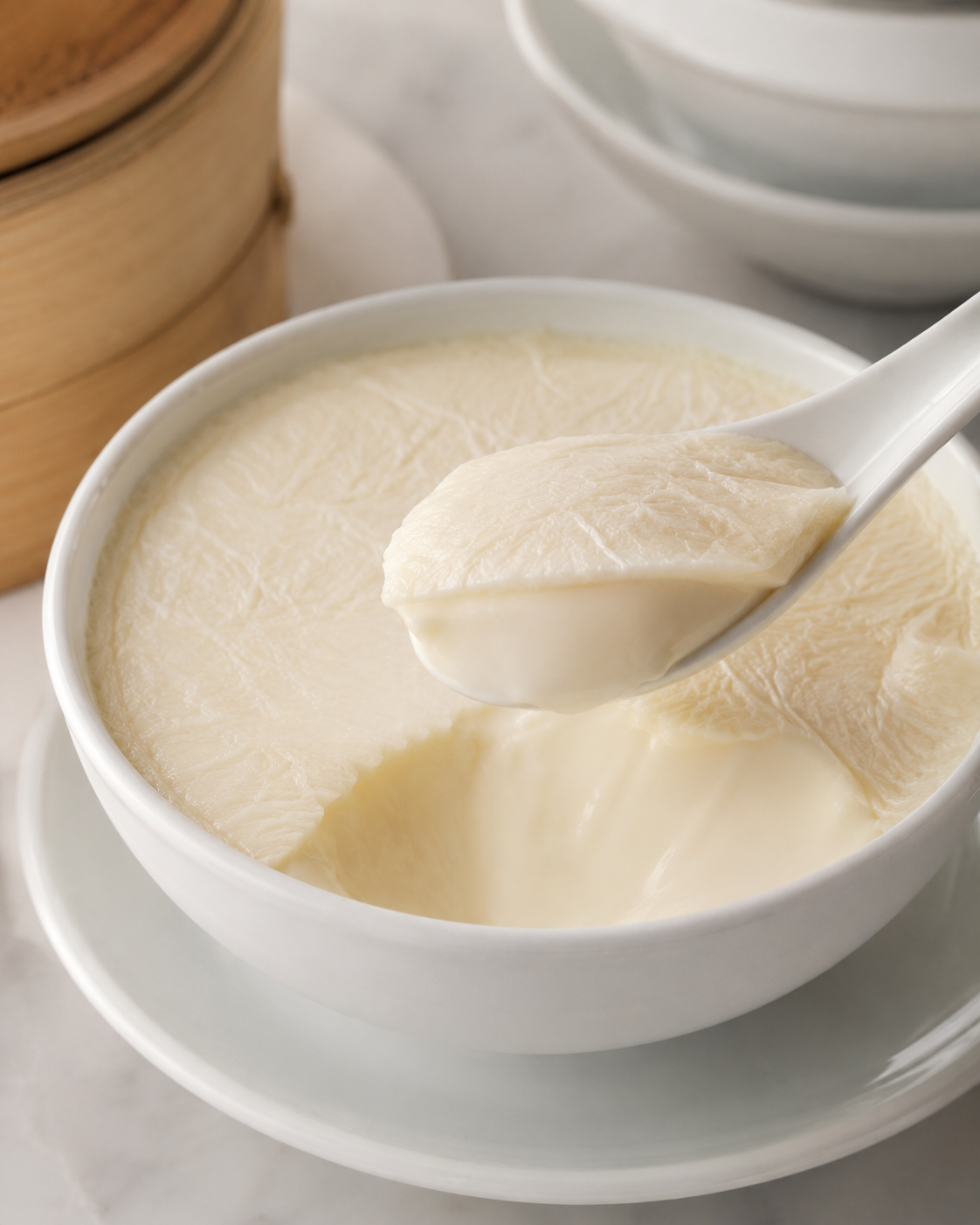
What is Double Skin Milk?
Double Skin Milk is a steamed milk-and-egg dessert associated with Shunde in Guangdong. It has a delicate film on top and a smooth, softly set body underneath.
Its English name translates 双皮奶 directly. The “double skin” refers to its traditional handling: a surface film is first allowed to form on heated milk, and another finished surface develops when the combined mixture is steamed.
How the characteristic surface is made
A traditional workflow described by China’s Ministry of Commerce begins by heating fresh buffalo milk and allowing it to cool until a skin forms. The milk beneath that skin is poured out, mixed with egg and sugar, strained, returned beneath the retained skin, and steamed. The finished surface is described as slightly wrinkled. Ministry of Commerce old-brand museum
This is a method description, not a recipe. Quantities, milk sources, sweetness, and commercial production methods vary.
For a focused explanation of the name and surface, see Why Is It Called Double Skin Milk? The Texture and Method Explained. To compare it with a familiar chilled dessert, read Double Skin Milk vs Panna Cotta.
Texture and service
The dessert should be softly set rather than firm like a baked cake. Its surface can appear thin or faintly wrinkled, while the interior is smooth and custard-like.
Double Skin Milk may be served warm or chilled. Because both are normal presentations, the Atlas uses the controlled temperature value varies.
For another steamed Chinese sweet, explore White Sugar Sponge Cake. Egg helps Double Skin Milk set into a soft custard; the rice cake is made from fermented rice batter. The two share a cooking method, but differ in ingredients and structure.
Regional context
Double Skin Milk is closely associated with Shunde food culture. China’s Ministry of Culture and Tourism includes the traditional technique in a Shunde intangible-cultural-heritage food itinerary. Ministry of Culture and Tourism
A Ministry of Commerce profile also identifies milk, egg, and sugar as core ingredients and reports provincial intangible-cultural-heritage recognition in Guangdong. Ministry of Commerce old-brand museum
These sources support the regional association and protected technique. They do not establish one uncontested origin account, so the Atlas does not assign an origin region.
Allergen note
Milk and egg are defining ingredients in the documented traditional method and are major allergens under the FDA’s U.S. framework. Individual products may contain additional ingredients or encounter cross-contact. U.S. Food and Drug Administration