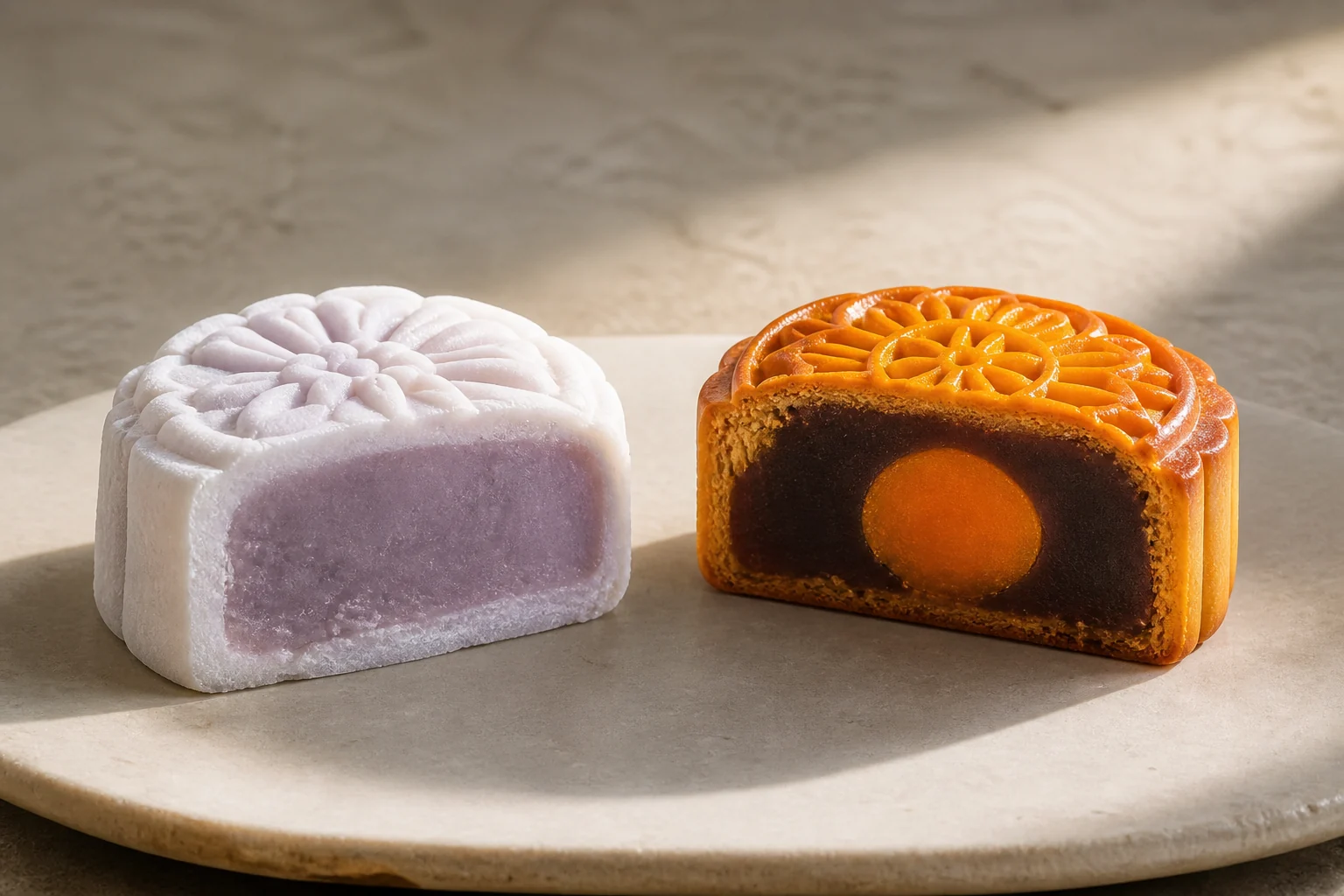
Baked mooncakes use a pastry wrapper that is baked after shaping. Snow-skin mooncakes (冰皮月饼, bīng pí yuèbǐng) use a soft wrapper that is cooked before assembly, then molded and served chilled rather than baked as a finished cake. The main choice is pastry versus chewiness—and whether you can maintain cold storage.
For the broader category, see the Mooncake Dessert Record. For a beginner flavor map, see What Does a Mooncake Taste Like?.
Snow skin vs baked mooncakes at a glance
| Feature | Baked mooncake | Snow-skin mooncake |
|---|---|---|
| Outer layer | Baked pastry; thin, tender, firm, or flaky depending on style | Soft cooked flour-and-starch wrapper |
| Final step | The filled, shaped cake is baked | The wrapper is cooked first; the assembled cake is not baked |
| Texture | Tender, dense, crisp, or flaky | Soft, chewy, and slightly sticky |
| Serving | Often room temperature, but follow the package | Chilled |
| Storage | Depends on formula and packaging | Refrigeration is normally required |
| Transport | Often simpler when the label permits room-temperature storage | Requires reliable cold handling |
What is a baked mooncake?
“Baked mooncake” covers more than one regional structure. A familiar Cantonese example has a thin tender shell around a dense filling; a Suzhou example may have many flaky layers. The oven step unites them, but it does not make their textures identical.
Fillings include lotus seed, red bean, nuts, salted egg yolk, meat, custard, and many modern combinations. Use the regional or crust name to understand the wrapper and the filling guide to understand the center.
What is a snow-skin mooncake?
Snow skin has a pale, yielding wrapper and is generally served cold. “Mochi-like” is a useful texture clue, not an ingredient guarantee or a claim that the foods are identical. One documented recipe uses glutinous rice flour, ordinary rice flour, wheat starch, milk, sugar, and oil, but commercial and homemade formulas vary.
Snow-skin color does not reliably identify a filling. Read the label for the center, allergens, and cold-storage directions.
Which fillings work with each format?
Both formats can hold pastes, custards, fruit-flavored fillings, chocolate, nuts, or egg yolk. A dense paste often emphasizes the structure of a thin baked crust, while a softer filling can complement a chilled wrapper. These are common pairings, not compatibility rules.
Neither wrapper is automatically healthier, vegan, gluten-free, dairy-free, or allergen-free. Baked crusts commonly contain wheat and may contain egg; snow-skin recipes may contain wheat starch or milk. Check each package.
How should you store and transport them?
The safest rule is to follow the manufacturer’s package. The Singapore Food Agency advises refrigerating snow-skin mooncakes as soon as possible after purchase and following package storage instructions and expiry dates.
Hong Kong’s Centre for Food Safety advises keeping snowy mooncakes at 4°C (39°F) or below and using an icebox outdoors. Its consumer guidance also says to discard snowy or ice-cream mooncakes kept at room temperature for more than two hours. These are jurisdiction-specific safety instructions, not universal shelf-life numbers for every product.
- At home: refrigerate snow skin promptly; store baked products as labeled.
- While traveling: use an insulated container for chilled products and minimize time out of refrigeration.
- When gifting: tell the recipient when the box needs cold storage.
- At a gathering: take chilled mooncakes out only when serving and apply local safety guidance if temperature control is lost.
Which should a beginner choose?
Choose baked if you want pastry texture or need a product that the package permits you to carry at room temperature. Choose snow skin if you prefer a soft chilled chew and can keep it reliably cold. Then choose the filling separately.
For flaky baked subtypes and broader regional variation, continue to the Regional Mooncake Starter Guide.